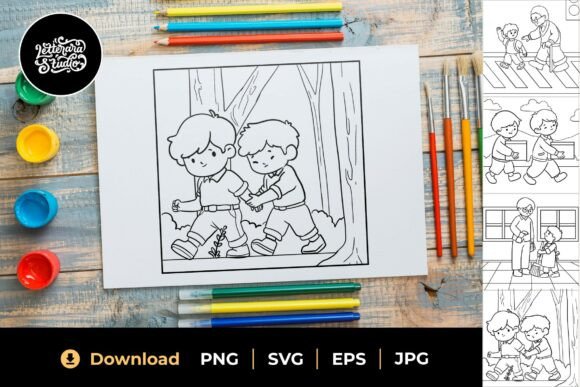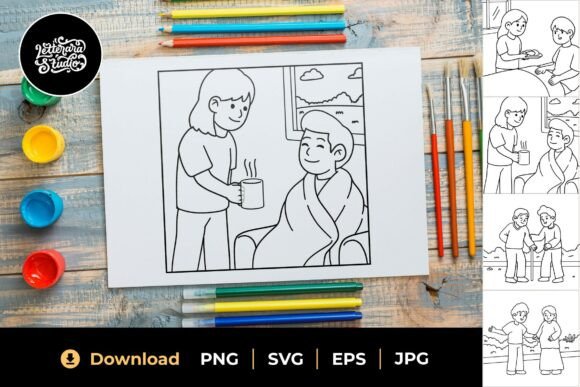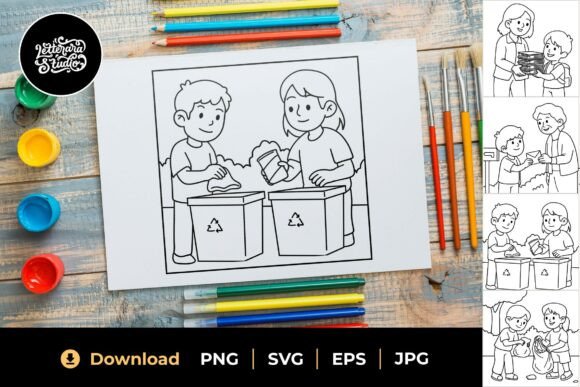
Reviewing Helping Friends Coloring Sheet 01 for Embroidery
As a designer who spends half my life digitizing and the other half stitching, I have learned that not every graphic translates well to thread. We often browse marketplaces looking for the next big seller, scrolling past thousands of Illustrations and Graphics, hoping to find something that holds up under the needle. Recently, I pulled up Helping Friends Coloring Sheet 01 to evaluate its potential for real-world application. My goal was not just to admire the artwork, but to determine if it could survive the transition from a digital screen to a tangible, stitched product.
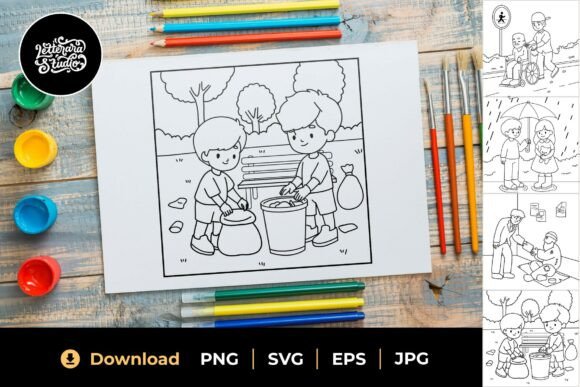
The first impression of Helping Friends Coloring Sheet 01 is one of warmth and approachability. The theme centers on kindness and teamwork, featuring children sharing and caring. Visually, this creates an immediate emotional connection. For an embroidery designer, however, the aesthetic appeal is only half the battle. The other half is technical viability. When I examined the line work and composition, I noticed the design relies heavily on clear, distinct shapes rather than intricate shading. This is generally a positive sign for embroidery, as complex gradients are difficult to replicate with thread without becoming muddy or overly dense.
Visual Personality and Project Fit
The mood of Helping Friends Coloring Sheet 01 is inherently gentle. It does not scream for attention with aggressive lines or chaotic elements. Instead, it invites a slower, more thoughtful viewing experience. This makes it an ideal candidate for products where comfort and sentiment are paramount. I immediately envisioned this design on a tote bag design intended for a library book club or a community garden group. The narrative of helping each other aligns perfectly with the utility of a reusable bag.
Another strong contender for this artwork is sweatshirt embroidery. The cozy nature of a fleece or cotton blend sweatshirt complements the soft message of the illustration. When placed on the left chest or as a larger back print, the design acts as a statement piece that feels personal rather than corporate. It also works beautifully for baby embroidery projects. Parents are increasingly seeking items that convey values like empathy and cooperation, making this a smart choice for nursery decor or personalized blankets.
Real-World Application Scenarios
To truly test the versatility of Helping Friends Coloring Sheet 01, I mentally walked through several production scenarios. Imagine a small shop owner preparing for a holiday market. They need items that sell quickly but also stand out. An embroidered patch featuring this design could be a hit. Patches are low-risk for customers and allow for creative placement on jackets, backpacks, or hats. Because the design features distinct characters, it would translate well into an applique design, where fabric pieces are used for the bodies or clothing of the children, reducing stitch count and adding texture.
For Etsy sellers, this graphic offers excellent potential for custom apparel. A mother might order a matching set for her children, emphasizing the theme of sibling teamwork. In this context, the clarity of the lines in Helping Friends Coloring Sheet 01 is crucial. If the details are too fine, they may get lost in the stitching process, especially on smaller garments. However, if the lines are bold enough, the finished product will look professional and crisp, enhancing buyer engagement and trust.
I also considered its use in holiday embroidery. Gifts that celebrate friendship and community are timeless during the festive season. A pillow cover or a kitchen towel embroidered with this scene could serve as a heartfelt personalized gift. The key here is scaling. The design must be large enough to show the interaction between the characters but small enough to fit standard hoop sizes without requiring excessive trimming or re-hooping.
Technical Considerations and Stitching Clarity
While the concept is strong, the execution depends on how the machine embroidery design is digitized. Since Helping Friends Coloring Sheet 01 originates as a coloring sheet, it likely consists of outlines. In embroidery, we cannot simply "print" lines. We must choose between running stitch, satin stitch, or fill stitch. A pure running stitch might look too sparse on certain fabrics, while a satin stitch could become bulky if the lines are wide. A skilled digitizer would likely use a combination, perhaps using satin columns for the outlines and light fill stitches for any interior details.
Stitch density is a critical factor. If the design is too dense, it can pucker the fabric, especially on lighter materials like cotton tea towels or thin t-shirts. Conversely, if it is too loose, the underlying fabric might show through, breaking the visual continuity. I recommend testing the embroidery file on scrap fabric that matches your final product. This allows you to adjust tension and density before committing to the final piece.
Fabric texture also plays a significant role. On textured fabrics like terry cloth or fleece, fine details can disappear. For Helping Friends Coloring Sheet 01, I would advise simplifying any tiny facial features or small accessories if stitching on plush materials. On smooth fabrics like poplin or polyester blends, the design will retain more fidelity, allowing for sharper definition in the characters' expressions and actions.
Navigating Challenges in Production
There are specific situations where this design requires careful handling. Small hoop sizes, such as 4x4 inches, may force you to crop the image, potentially losing the context of the "helping" action. If the interaction between the characters is cut off, the message is lost. Always check the aspect ratio and ensure the core narrative remains intact within your chosen hoop size.
Dark fabrics present another challenge. If the original Illustrations rely on black outlines, stitching black thread on a navy or black garment will render the design invisible. You will need to adjust the thread colors to create contrast. Using a light-colored thread for outlines or adding a white underlay can help the design pop against dark backgrounds. Additionally, when working on stretchy fabrics, a proper stabilizer is non-negotiable. Without it, the design may distort during washing, ruining the finished product.
Curved surfaces, such as caps, require extra attention. The design should be centered carefully to avoid wrapping around the seam. If the characters are too wide, they may distort on the front panel of a cap. In such cases, resizing or selecting a simpler version of the graphic might be necessary.
Enhancing Brand Value and Customer Trust
Using high-quality, meaningful designs like Helping Friends Coloring Sheet 01 can significantly boost your brand consistency. When customers see thoughtful, well-executed embroidery, they perceive higher value. This is particularly important for craft business owners who rely on repeat clients. A handmade product that tells a story connects on a deeper level than a generic graphic.
For commercial embroidery projects, such as uniforms for daycare centers or community organizations, this design reinforces the values of the institution. It shows attention to detail and a commitment to positive messaging. This professionalism builds customer trust and can lead to larger bulk orders.
Practical Designer Notes
Before you purchase or download this digital embroidery file, there are several steps you should take. First, confirm the licensing terms. Ensure that the license allows for commercial embroidery if you plan to sell finished items. Some licenses restrict the number of copies you can produce, so read the fine print.
Second, verify the file formats provided. Ensure compatibility with your embroidery machine software. Common formats include PES, DST, and EXP, but this varies by manufacturer. If the format list is not clearly provided in the description, contact the seller before purchasing.
Third, create a printable mockup or a digital preview to visualize the design on different products. This helps you decide on the best placement and size. Test the design in black and white to check for contrast issues. If the details blend together in grayscale, they will likely blend together in thread as well.
Finally, always keep a record of your test stitches. Note which stabilizers worked best, which thread brands provided the best coverage, and what tension settings were required. This data becomes invaluable as you expand your small shop product line.
In conclusion, Helping Friends Coloring Sheet 01 offers a charming and versatile option for embroidery projects. Its strength lies in its emotional resonance and clear visual structure. By paying attention to technical details like stitch density, fabric choice, and color contrast, you can transform this graphic into a stunning embroidery project that delights customers and enhances your portfolio. Whether for a personalized gift or a boutique collection, this design has the potential to shine when handled with care and expertise.